
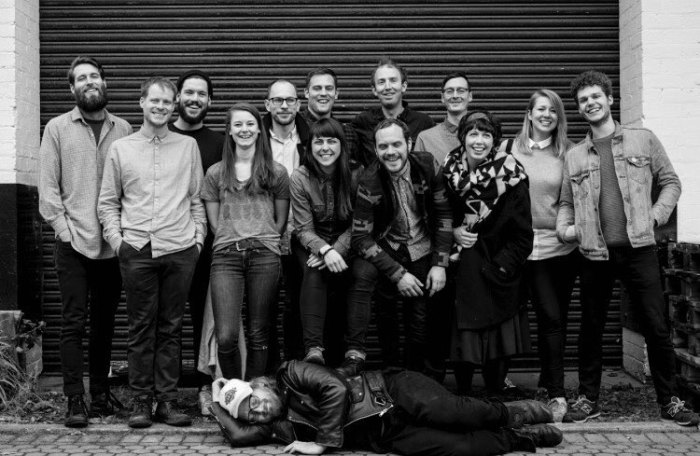
It has been just over a week since I took part in the UK Roasters Championship. I must say that the event was absolutely fantastic. It was quite a different scene from the Barista Competitions that I have taken part in. What do I mean? The roasting championship felt extremely friendly, collective and collaborative. It was highly communal, with most competitors discussing and sharing ideas. Barista Championships often do not have this kind of charm. They are much more intense, competitive, and individual. Competitors seemed more focused on their own performance and less so on the collaborative aspects that the roasters seemed to have. Roasters were discussing their findings, sharing their personal experiences, cupping each other’s coffees, and providing each other feedback. I found it incredibly inspiring and welcoming, being the only participant who is not a ‘roaster’. Now, I am not sure if the reason it had a different vibe is because roasters themselves, unlike baristas, are often out of the spotlight and therefore have less of a performative approach to the competition. Are production roasters inherently different from Baristas, in that the personality type attracted to each profession dictates the vibe of ‘competition’? Or perhaps it is that the UK Roasting Championship is quite new, and therefore has not built up the intense competitive tension that I often find in Barista Championships? Or… perhaps it has to do with the structure of the competitions? Baristas spend months on end preparing a routine that they will have fifteen minutes to deliver. Roasters will only be able to utilise skills they have gained in their coffee career to deduce the information they need to produce their roast, which all takes place over a period of three days. I am sure many have seen a Barista Competition, and thus understand what I mean when I mention this fifteen-minute routine that the barista prepares for. But many will not have seen a roasting championship, as they aren’t structure to be a spectator’s sport. This makes sense even within the normal working day, where baristas act as the customer facing ‘performer’, while roasters often work behind closed doors. Let me then take a moment to post on how the competition works for those who may be interested in competing in the future.
What you will have to submit:
1x Green Grading/ Green evaluation sheet, for the single origin coffee you will roast. On this sheet you must note any green coffee defect counts found, moisture, density, colour, odour, screen size and general coffee origin information.
1.5 kilos of a single origin, chosen by the sponsors and organisers. In our case, it was Kenya Kathakwa AA.
1.5 kilos of a blend of three coffees, also chosen by the sponsors and organisers, whereby you must use at least 10% of each in order to qualify.
1x detailed roasting plan for all the coffees you will roast, including description of the final cup quality you plan to achieve (Taste balance, flavour notes, acidity, body) and why and how you plan to plot your heat application/it’s significance.
Prior to the competition, there is only so much preparation that a person can do. You cannot roast the coffee beforehand, you do not know the coffees you will be require to roast, and you most likely will not have ever worked on all of the equipment available. And even if you have worked on the same type of roaster that you will be using in the competition, you cannot necessarily use the exact same roast curves you have used on your own roaster. Each roasting machine will have a different set up, which means that what you did in your roastery does not necessarily work on this roasting machine. Even more so if the roasting machine is a different size, and/or make. So, in some senses, everyone is starting from the same point.
On day one, all the competitors arrive for a lovely little meet and greet. In our case it was mostly familiar faces, which made it quite nice to be there as it doubled as a fantastic chance to catch up with the mates I haven’t seen in a while. Always a good reason to participate, in my eyes. Once all the competitors arrived, the lovely Mat North announced the coffees that we would be roasting. In our case it was a Kenya Kathakwa AA for the single origin, and Nicaragua Samaria (natural), Costa Rica Aquiares (honey), and Colombia Veracruz (washed) for the blend. In addition, we would be supplied with a separate coffee (with no name or indication of its origin) that we would be using during our practise time. Ill point something out right now: we were only going to get to practise roast with a coffee that wasn’t the one we would end up submitting. This means we would have to base our roast plans on a coffee that isn’t necessarily going to react the same as the ones we would eventually roast for submission. Pretty crazy.
After induction to the equipment, we were given time slots to complete the following tasks: sample roasting, green grading, and practise roasting. We were given 40 minutes for sample roasting, 40 minutes for practise roasting, and 30 minutes for the green grading section. Time crunch indeed! Because we were sample roasting on an Ikawa we could only really do 6 minute or less sample roasts, as we would need to sample roast the four coffees (to help up with the roasting plan since we weren’t going to get to taste the production roasts we would submit until after we had submitted them), within the forty minutes. It would seem like there should definitely be enough time, but not as such. Ikawa sample roasters need about 2 minutes to cool the beans, and anywhere from 30 seconds to 1 minute 30 seconds to heat up. If you do the maths, it means your roast can only be about six minutes. So again, all of us were in the same boat. We would all need to cup underdeveloped coffee and try to acquire as much information as possible.
Then came the green grading portion, where we would need to fill out the green grading form I described earlier in this post. Green grading was probably one of the most useful aspects of the competition, as it gave the competitor a chance to have a closer look at the green they were actually going to roast, and gather moisture and density information for later use/correlation.
We then roasted the practise roasts on the production roaster we would use for the final submission, which was a 2.5kilo diedrich. We had 40 minutes to get to know a roaster we had never roasted on, get to know a coffee we weren’t necessarily going to use, and wrap our minds around possible curves we might want to use in the future. I am sure that everyone went about this quite differently. I decided to draw out three different heat application ideas (via gas and airflow), keeping charge temp and in between batch protocol the same for them all, and then watch how they roast and stop them just as the coffee began to smell like it was hitting a certain sweet spot I was hunting for. I figured I could then cup them and see if my theoretical approach matched up with the results, and then decide which curve might work for what coffee. I found this approach worked quite well, as I was able to see how the curves were affected by both gas changes and airflow changes. The resulting two methodologies/curves (A and C, as B was pretty rubbish) I chose were derived from the data I collected in that room. The choice of whether A or C for each coffee was then based on what I wanted to get out of that coffee, as perceived by tasting through the underdeveloped sample roasts and trying to imagine what that could become. Because I decided to roast all coffees separately, due to differences in moisture and density, I needed to first decide what my ratios of each would be in the blend. From there, I could attach either A or C as a roasting plan.
I must have cupped so much coffee that day. It was around ten pm when we all finished up and left Dear Green. I had one beer and fell asleep quicker than a toddler in a car.
Day Two is basically show time. You have 1.5 hours to roast all the coffee you will need to produce the 1.5kilos of single origin and 1.5 kilos of the blend. And when you walk into that room you will have already submitted the roasting plan, therefore marrying yourself to what you said you would do. Points are given for accuracy between roast plan and actual roast, so in some ways you are just praying you can hit all the numbers correctly. Chances are, not every roast is going to go to plan, so efficiency and planning is key.
I managed to turn six batches during the time, only after a technical malfunction. No worries though, as I was given a technical time out and the lost time was added to my session time clock. But bloody hell, after the whole malfunction I knew that first batch was not going to go as planned. Luckily I had pre-weighed two batches of every coffee I was going to need to roast. So I was able to catch up after the second batch, completing six roasts and allowing myself a bit of choice before submission.
It isn’t until the final day that you get to cup the coffee. So you essentially spend the evening either thinking about the curves and how the roasts went, or not thinking about it all and chilling out with several glasses of wine. I reckon almost all of us chose option B, which makes sense as what the heck can you do now anyway? J But the evening was just as lovely as the day time. Everyone chatting about various subjects, many of which did not involve coffee. Again… everyone at that competition was absolutely lovely and I felt happy just to be there skill sharing and exchanging ideas.
When we did finally get to cup them, we did not know who’s was who’s. So we were able to just cup them without any bias. Most of us were mildly hungover, which added to the bonding via commiseration.J That and the excitement of waiting for results…which came quite late in the evening. The judges have quite a lot to mark and calculate and I am so thankful for their help.
Now I went into this competition only expecting to learn. I am not a production roaster, and knew that I only had a few weeks to learn how to roast, but thought this kind of challenge would force me to learn more like a child does. I didn’t mind if I was last, as I knew I’d walk away with so much more knowledge than before. I felt that during the weeks I trained up, as well as during the days I was there. The information gained is incredibly, and the learning curve steep. I don’t think I’ve learned that much in ages.
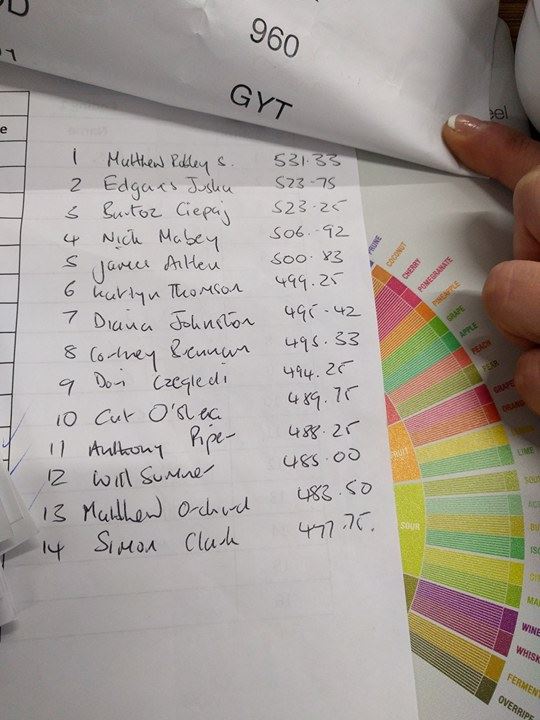
Surprisingly, I place 7th! I am incredibly thankful to my colleagues for all their help. It reinstates my confidence in the fact that we can learn anything we want if we put our minds to it. What is more, it has peaked my interest in continuing to roast and allowed me to connect with others who may be able to mentor me on that journey.
So are roasters different from baristas, with regard to the vibe they create in competition? Is it that we spent three days together, bonding over the same confusions and puzzles? Or is it that it is such a new competition? I guess on some hand I do really wonder, but on another hand I don’t care. I just hope the humility I felt in that room, is one that continues to grow within our industry. I felt incredibly inspired by all the coffee professionals I spend time with over that weekend, and hope to continue to build relationships with such talented and brave individuals.
And for those of you thinking about competing in the roasting championship in the future: do it. So far, of the competitions I have taken part of in the past, it is my favourite.
 Roastersaurus